Posts Tagged ‘Travel’

Crossing Paths with John Wesley

September 26, 2008
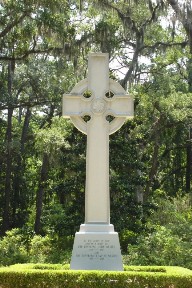
The monument to John and Charles Wesley in Wesley Garden, St. Simons Island.  June 24, 2008.

The monument to John and Charles Wesley in Wesley Garden, St. Simons Island. June 24, 2008.

When Betsy and I were planning our anniversary trip this year, we knew about the Methodist Conference Center, Epworth By The Sea, on St. Simons Island.  Since Betsy worked for the Methodist Church for many years, we knew we wanted to stop by there.

But what we didn’t expect was to encounter John Wesley in so many places.  When we got to Fort Pulaski (on Cockspur Island, Georgia) the first historical marker we saw was to John Wesley.  The marker pointed out that John Wesley landed on Cockspur Island on February 6, 1736, and preached his first sermon in America.  A monument has also been erected on Cockspur Island to commemorate the event.

John Wesley arrived in Savannah, Georgia, on February 8, 1736.  He remained in Georgia until December 22, 1737.  During that time he served as rector to the church in Savannah, and today there is a Wesley Memorial Church in Savannah and a statue of Wesley in Reynolds Square.

During the time Wesley was in Georgia he also went to St. Simons Island and ministered to the settlers in Frederica.  During his visits to Frederica, John Wesley preached near the present Christ Church, Frederica.  There is now a Wesley Garden at the site.

To more of our encounters with John Wesley, click HERE.
A Last Look At St. Simons

September 24, 2008
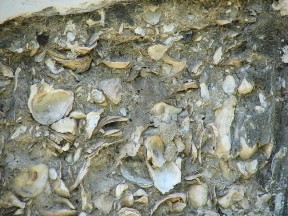
Tabby (oyster shells, lime, ash, sand and water) was used in construction during the colonial period.

Tabby (oyster shells, lime, ash, sand and water) was used in construction during the colonial period.

Betsy and I thoroughly enjoyed our visit to St. Simons Island in June of this year.  The highlights of our time on the island were the Lighthouse, Epworth By The Sea, Fort Frederica, and Christ Church, Frederica.  But there were many other interesting things to see on the island.

I’ve always been fascinated by ships and the sea.  In 1961 I was in Boston and had the opportunity to tour U.S.S. Constitution, the famous Old Ironsides.  I must admit that it was awesome to be able to board that piece of history.

One of the places we visited on St. Simons was Gascoigne’s Bluff.  The bluff has been an Indian settlement before the English arrived, the site of the most beautiful plantation on the island, and the headquarters of a Spanish invasion in 1742.  But what was most interesting to me was the fact that the timbers that were used to construct Old Ironsides in 1794 came from trees growing on Gascoigne’s Bluff.  In 1874 timbers from this bluff were used in the construction of the Brooklyn Bridge.

We also visited two slave cabins on what was once the Hamilton Plantation.

We also visited the site of the Battle of Bloody Marsh.  This was the place where the British ambushed the Spanish in 1742 and won a decisive victory which resulted in the Spanish leaving St. Simons Island and returning to St. Augustine.

To see more of St. Simons Island click HERE.

Christ Church, Frederica

September 22, 2008
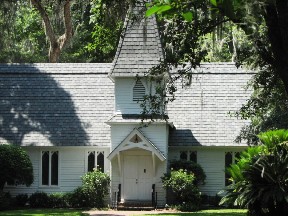
Christ Church, Frederica, St. Simons Island.  June 25, 2008.

Christ Church, Frederica, St. Simons Island. June 25, 2008.

While Betsy and I were visiting St. Simons Island in Georgia, we stopped at Christ Church, Frederica.  Christ Church is an Episcopal Church built on the site of the first Episcopal church on the island.

Actually, the history of worship on the site goes back even further.  In March, 1736, Charles Wesley held worship services for the new settlers at Frederica.  In 1737 John Wesley established a church for the people of Frederica and the other settlement on the island, Fort St. Simon.  When John Wesley left St. Simons he was replaced by George Whitefield.  All three men held services on the site of the present church.

The building of a church structure was delayed by the Revolutionary War, and it wasn’t until 1810 that the construction of a church building on the site began.  The building was completed in 1820 and used until the Civil War.

Returning at the end of the Civil War, residents of St. Simons found Union troops had destroyed much of the church.  Windows had been broken, pews smashed and burned, the roof was heavily damaged and both the altar and the organ had been destroyed.

The congregation met in homes until 1884, when Anson Green Phelps Dodge rebuilt the church as a memorial to his first wife.  It is this church which we visited.  The church building is cruciform in design, with a trussed Gothic roof.  The building contains beautiful stained glass windows depicting incidents in the life of Christ and the early history of the church on St. Simons.

To see more of our visit to Christ Church click HERE.

Fort Frederica

September 19, 2008
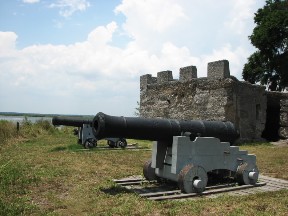
Cannon along the river at Fort Frederica.  June 25, 2008.

Cannon along the river at Fort Frederica. June 25, 2008.

After visiting Epworth By The Sea on St. Simons Island, Betsy and I drove  to Fort Frederica National Monument, also on the island.

The town of Frederica was founded by General James Oglethorpe in 1736, three years after the founding of the Georgia colony at Savannah.  In the 1730s Great Britain was engaged in a struggle with Spain for land in what is now the southeastern United States.  Both countries claimed the land between St. Augustine (held by the Spanish) and Charleston (held by the British).  The British founded Georgia to serve as a buffer along their southern frontier.

In 1736 Oglethorpe landed on St. Simons Island with 44 men (mostly skilled workers) and 72 women and children.  Their first task was to build a fort to command the river, but they then built the town of Frederica.  By the 1740s Frederica was a tsubstantial village of about 500 people which would easily fit in the English midlands.

War broke out between Spain and Great Britain in 1739.  In 1742 the Spanish invaded St. Simons and got to within sight of Frederica, but were beaten back.  Later that same day the British won a decisive victory against the Spanish at Bloody Marsh and the Spanish left the island within a week.

Peace brought about the fairly rapid decline of Frederica as soldiers were no longer stationed in the  town.  The town survived a fire in 1758, but fell into ruin soon thereafter.

To see more of our trip to Frederica click HERE.

Epworth By The Sea

September 17, 2008
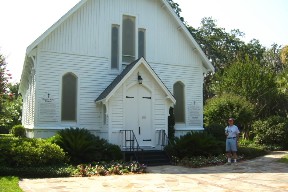
George at Lovely Lane Chapel, Epworth By The Sea, Georgia.  June 25, 2008.

George at Lovely Lane Chapel, Epworth By The Sea, Georgia. June 25, 2008.

When we were planning our anniversary trip Betsy wanted us to go to St. Simons Island, since she had been there previously and wanted to show me around.  In addition to St. Simons Lighthouse, she especially wanted me to see Epworth By The Sea, the Methodist Conference Center on the island.  The purpose of Epworth is to provide a Christian place for worship, study and fellowship.

The ties between Methodism and St. Simons are strong.  John and Charles Wesley, founders of the Methodist Church, visited St. Simons Island and Fort Frederica in March of 1736.

One of the features of Epworth By The Sea is Lovely Lane Chapel.  The chapel is a church built in 1880 as St. James Union Church and is now the oldest church building on St. Simons.  When the Methodist Church purchased the property containing the church in 1949, the church was renamed Lovely Lane Chapel after the site of the 1784 founding conference of American Methodism in Baltimore, Maryland.

Epworth By The Sea is a beautiful place and I understand why Betsy wanted to share it with me.  To see more of our visit to Epworth By The Sea click HERE.

St. Simons Light

September 14, 2008
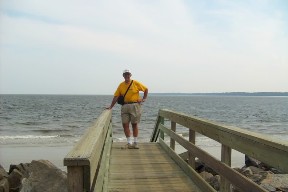
George at the walkway leading to the beach at St. Simons Lighthouse.  June 24, 2008.

George at the walkway leading to the beach at St. Simons Lighthouse. June 24, 2008.

On our anniversay trip, after exploring Savannah for much of the day, we headed south to St. Simons Island.  We reached St. Simons in the afternoon and went to the lighthouse, which was built in 1872.  The lighthouse and keeper’s house are the oldest surviving brick structures in Glynn County, Georgia.  The lighthouse is 104 feet tall and is open to the public, but we passed on the opportunity to walk up the 129 steps to the top!

The present lighthouse is the second on the site.  The original lighthouse was built in 1807 and lasted until 1862, when it was blown up by retreating Confederates when they abandoned St. Simons.

We visited the beach and park near the lighthouse.  The park contained several huge live oak trees which we paused to admire.

After driving around St. Simons for a little bit, we decided to try one of the local restaurants for dinner.  To see more of our visit to St. Simons Lighthouse, click HERE.

Walking Through Savannah Squares

September 9, 2008
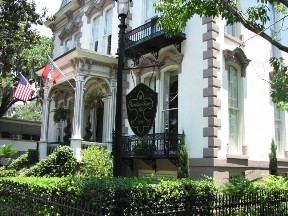
The Hamilton-Turner Inn on Lafayette Square, Savannah.  June 24, 2008.

The Hamilton-Turner Inn on Lafayette Square, Savannah. June 24, 2008.

After Betsy and I left the Cathedral of St. John the Baptist in Savannah, we had a little time to walk around a couple of the squares nearby.

The Cathedral is on Lafayette Square, which is named for the Marquis de Lafayette, the Frenchman who served as George Washington’s aide de camp during the Revolution.  Until 1846 the Savannah City Jail was located beside this square.  In 1983 the National Society of the Colonial Dames of America installed a fountain in the center of this square commemorating the 250th anniversary of the founding of Georgia.

The Hamilton-Turner Inn, built in 1873, faces Lafayette Square, as does the home of Georgia’s prize-winning 20th century author Flannery O’Connor.

We then walked along Macon Street, which contains some beautiful row houses, to Troup Square.

Troup Square is named for George Michael Troup, a native of the region who served as a Congressman, a Senator, and the Governor of Georgia.  Troup Square is smaller than most of the other squares and is made even more unique by its Victorian armillary.

The Unitarian Universalist Church (built in 1851) is on this square.  The organist and choir director of this church, James Pierpont, wrote the song “Jingle Bells”.

To see more of our walk through these Savannah squares click HERE.

The Cathedral of St. John the Baptist

September 3, 2008
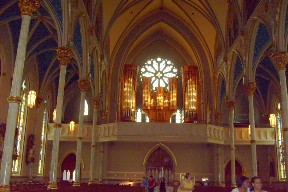
The organ of the Cathedral of St. John the Baptist, Savannah.  June 24, 2008.

The organ of the Cathedral of St. John the Baptist, Savannah. June 24, 2008.

When Betsy and I were planning our anniversary trip we did some internet research on our proposed destinations, especially Savannah since neither of us have ever been there before.  I knew about Fort Pulaski and I knew I wanted to visit the fort.  I knew that Savannah was a very historic and a very beautiful city, but that was about it.

One of the Savannah attractions mentioned in the AAA online tour book was the Cathedral of St. John the Baptist.  “This cathedral is one of the largest cathedrals in the South, and features marble railings, floors and altar.  In addition there are murals, stained-glass windows, large carved-wood stations of the cross, and a solid white-oak 2,081 pipe organ.”

Both Betsy and I decided the Cathedral would be a good place to visit.  Our tour of Savannah took us past the Cathedral, so we got a good idea of how to get back.  After our tour we drove back to the Cathedral and went in.

The Cathedral was everything the tour book said it would be and more.  It was physically beautiful and spiritually inspiring.  We would highly recommend this attraction to anyone visiting Savannah.

To see more of the Cathedral click HERE.

Heroics on Mount Tai

September 1, 2008
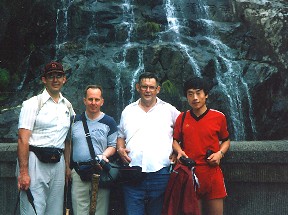
I'm on the left of this picture taken in July, 1990.

I

I was looking through some pictures yesterday when I came across the one above.  That picture was taken in 1990 at Tai Shan (Mount Tai) in China.  I was in China as part of an exchange  program between a Chinese university and Heidelberg College, the college at which I was teaching.

I had forgotten about the waterfall in the background — I guess I can’t add it to our waterfall ‘collection’ since I didn’t know Betsy back then.  The young man on the right is ‘Joe’, our guide from the Foreign Affairs Office of Tianjin Normal University.  The other two men are colleagues of mine — Richard Cordell taught Chemistry at Heidelberg while Mel Cassler taught Mathematics.  I taught Computer Science.

Our hosts had taken us to visit Mount Tai in Shandong Province.  Mount Tai is one of five sacred mountains in China, and is often called the “First Mountain Under Heaven”.  For most of China’s recorded history emperors went to Mount Tai to hold ceremonies of worship to the gods of heaven and earth.  The mountain contains 22 temples, over 100 other buildings and more than 1800 carved stones.  It’s an area rich in cultural history and is listed  as both a world natural and cultural heritage by UNESCO.

We were taken about half-way up the mountain to Mid-Heaven Gate, where we caught a cable-car to the top of the mountain.  While we were at the  top, ‘Joe’ asked if anyone would like to walk down the mountain to the bus rather than take the cable-car back.  He said if we made it down the 5,000+ stairs we would be made ‘Heroes of the Peoples Republic’.

All the younger members of our group declined “Joe’s” offer, but Richard, Mel and I took him up on it.  The picture above was taken after we got back down to the bus.

Savannah Tour

August 31, 2008
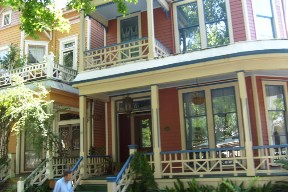
Victorian Row Houses in Savannah, Georgia.  June 24, 2008.

Victorian Row Houses in Savannah, Georgia. June 24, 2008.

The day after visiting Fort Pulaski and Tybee Island, Betsy and I went to downtown Savannah to tour the historic district.

Georgia was the last of the English colonies to be founded in North America.  James Edward Oglethorpe is considered the founder of Georgia, although he was only one of 21 persons named as trustees of the new colony.  An interesting provision of the original charter was that rum, lawyers and slavery were forbidden!

England had several reasons for founding Georgia.  Oglethorpe was personally interested in providing relief to the debtors of England and in helping the English poor and  unemployed.  The English crown wanted to remove the poor so England would not have to support them.  Another interest of the crown was to provide a buffer to protect South Carolina from Spaniards in Florida.

Oglethorpe and 120 other settlers arrived in what is now Savannah in February, 1733.  Oglethorpe soon became friends with a local Indian chief, Tomochichi.  Oglethorpe and Tomochichi pledged mutual goodwill and the Yamacraw chief granted the new arrivals permission to settle Savannah on its bluff above the river.  As a result the town flourished without warfare and the accompanying hardship the burdened many of England’s early colonies.

Savannah is known as America’s first planned city.  Oglethorpe laid the city out in a series of grids that allowed for wide open streets dotted with shady public squares and parks that served as town meeting places and centers of business.  Savannah had 24 original squares and 21 of them are still in existence.

I must admit that we didn’t enjoy our tour of Savannah as much as we enjoyed our tour of Charleston, but we did get a good overview of the historic district and are now ready to go back and take a walking tour!

To see more of our tour click HERE.