Archive for the ‘Travels’ Category

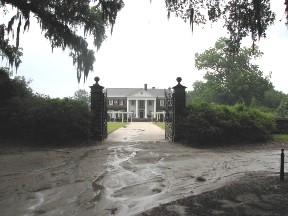
Boone Hall Plantation

July 25, 2008


The two major destinations on our anniversary trip were Charleston and Savannah. We did visit some waterfalls in north Georgia on our way south, but we arrived in the Charleston area on June 21.

Our first stop was Boone Hall Plantation in Mt. Pleasant, South Carolina. Boone Hall is one of America’s oldest working plantations. It was once known for cotton and pecans, but now produces peaches, strawberries, tomatoes and pumpkins, as well as other fruits and vegetables.

Boone Hall Plantation (including the first floor of the main house) has been open to the public since 1956. In the 1980s Boone Hall was featured in the mini-series North and South. Later it was used in the filming of Queen, the sequel to Alex Haley’s Roots.

Boone Hall Plantation got it’s start in 1681 when Theophilus Patey was granted 470 acres of land on Wampacheeoone Creek. John Boone, who arrived in South Carolina in 1672, married Patey’s daughter and the couple received the 470 acres as a wedding present. It was after the marriage that the plantation began to be known as Boone Hall. By 1811, when the Boone family sold the plantation it had increased to 1,452 acres.

Over the next 150 years Boone Hall was sold several times. Over those years the plantation increased in size to 4,039 acres and became one of the leading producers of pecans in the country. In 1955 the McRae family, who still own the plantation, purchased Boone Hall and opened it to the public.

One of the features of Boone Hall is an avenue of oaks — a three-quarter mile driveway leading to the main house lined with massive Spanish-moss draped Live Oaks. The Avenue of Oaks goes back to 1743. The present manor house was built in 1935 on the site of the original house.

To see more of our visit to Boone Hall, click HERE.

America the Beautiful

July 23, 2008

What is the real America?  Is it the big cities we see on television or in the movies, or is it the simpler America of Norman Rockwell?  One reason Betsy and I enjoy living on the Cumberland Plateau is that life here is a little slower and a little simpler than it would be in a larger city.

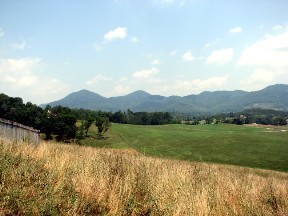
This weekend we travelled to a portion of the country that is almost as beautiful as our plateau — southwestern Virginia.  We were able to stay off interstate and other major highways most of the time and got to see the America that exists away from the interstate highways.

Betsy’s hometown is Big Stone Gap, Virginia.  BSG is a small city nestled in the mountains.  It used to be a center for coal mining, but most of the mines in the area have now closed.

But the mountains are still there and they are grand to behold.  Between the mountains are many wide valleys which contain rolling hills and many farms and small towns.  Every hill and every curve seemed to present a picture postcard view.

It’s hard to put into words the way we felt about the countryside through which we travelled.  Perhaps the best way to put it is to say the Norman Rockwell’s America still exists.

Fort Sumter

July 13, 2008

Three weeks ago Betsy and I were in Charleston, South Carolina. I had been there several times, but Betsy had never been there.

We didn’t have time to take the boat out to Fort Sumter, one of Charleston’s most famous historical sites.

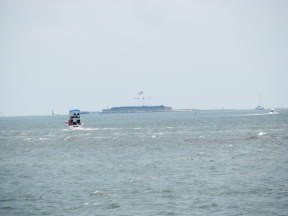
But we did catch a glimpse of Fort Sumter from the Battery (more properly known as White Point Gardens), which sits on the southernmost edge of the Charleston peninsula, where the Cooper and Ashley Rivers meet to flow into the Atlantic Ocean.

Fort Sumter was built on a man-made island in Charleston Harbor. Fort Sumter, a masonary fort, was part of the third system of defenses constructed along the coast and was unfinished when South Carolina seceded from the Union on December 21, 1860. U. S. Army Major Robert Anderson moved his command to Fort Sumter five days later because he felt it was the most defensible position in Charleston harbor that could be held by the Union.

On April 12, 1861, Confederate batteries around Charleston harbor opened fire on Fort Sumter for what became a 33 hour bombardment. After that time Major Anderson surrendered the fort because red-hot shells and started fires in all the wooden structures of the fort and were threatening to explode the powder magazines.

No Union soldiers were killed in the bombardment, but one Union soldier was killed and another mortally wounded on April 27, during the firing of a salute to the American flag allowed by Confederate authorities.

Fort Sumter remained in Confederate hands until February 22, 1865, when Union troops of General Sherman occupied the fort after the evacuation of Charleston by the Confederates.