Posts Tagged ‘Travel’

Tybee Island

August 29, 2008
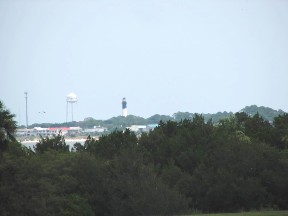
Tybee Island and lighthouse from the walls of Fort Pulaski.  June 23, 2008.

Tybee Island and lighthouse from the walls of Fort Pulaski. June 23, 2008.

I mentioned a couple of days ago that Betsy and I visited Fort Pulaski while on our anniversary trip in June.  From the walls of Fort Pulaski we could see Tybee Island and its lighthouse, and since Betsy is as interested in lighthouses as I am in Robert E. Lee, we had to go over to Tybee and visit the lighthouse.

Tybee Island and Fort Pulaski (on Cockspur Island) are closely connected.  In 1861 Confederates held both Tybee Island and Fort Pulaski.  But in November of that year the Union army and navy captured Hilton Head Island (South Carolina) on Port Royal Sound.  Hilton Head is only about 15 miles north of Fort Pulaski, and using this as a base the Union was able to mount operations against Fort Pulaski and the entire South Atlantic coast.

Since the Confederate troops on Tybee Island were in danger of being cut off by the Union navy, Robert E. Lee ordered that they be withdrawn.  He did this because he felt Fort Pulaski was impregnable. but by doing so he unknowingly gave the Union the only site from which Fort Pulaski could be taken.

The Union army under Engineer Captain Quincy A. Gillmore quickly began to build siege batteries on the only firm ground in the area — the northwestern shore of Tybee Island.  Although this site was over a mile from Fort Pulaski, Gilmore had ten of the new rifled cannon available and he was certain that these cannon could breach the brick walls of Fort Pulaski and force its surrender.

On April 10, 1862, after the Confederates refused Gillmore’s formal demand for surrender, the Union forces opened fire on the fort.  The rest, as they say, is history.
My Favorite Island: Antigua

August 27, 2008
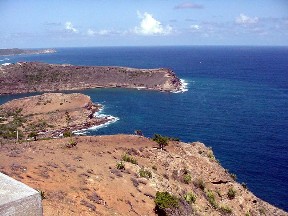
The coast of Antigua from Shirley's Height.  September 12, 2001.

The coast of Antigua from Shirley

This past Sunday afternoon Betsy and I were watching DVDs of our grandchildren when we decided to watch a DVD of our honeymoon cruise in the eastern Caribbean.  We visited several islands — St. Thomas, St. Maarten, Antigua, St. Lucia and Barbados.  It was a wonderful cruise.

Betsy asked which island was my favorite.  That wasn’t an easy question to answer, but I finally had to say Antigua.  The coast of Antigua was absolutely breath-takingly beautiful.  The ocean was a gorgeous blue in contrast to the rocky cliffs.

In addition to rocky shores Antigua also has beaches and history.  In 1784 British Admiral Sir Horatio Nelson established a base on Antigua for use against the French.  We were able to visit that base, Nelson’s Dockyard.

Our day in Antigua began with a beautiful sunrise and ended with a gorgeous sunset.  To see more of our visit to Antigua click HERE.

Fort Pulaski

August 26, 2008
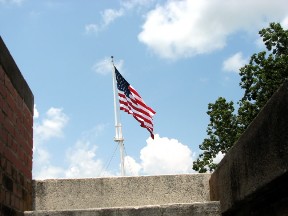
The flag flying at Fort Pulaski.  June 23, 2008.

The flag flying at Fort Pulaski. June 23, 2008.

In the early 1800s the United States constructed a third system of forts to protect the East and Gulf coasts from invasion.  Most of those forts still exist.

The fort constructed to protect Savannah, Georgia, was named Fort Pulaski in honor of the Polish Count Casimir Pulaski, who lost his life fighting against the British at Savannah during the Revolutionary War.

Fort Pulaski was designed to be one of the most modern fortifications ever built.  Many considered the fort’s 7½-foot solid brick walls backed with massive masonry piers unbreachable.  Construction of the fort started in 1829 and required $1 million dollars (that was real money back then!), 25 million bricks, and 18 years of work to finish.

Unfortunately for the designers of the fort technology did not stand still after the fort was complete.  The rifled cannon was perfected which had both greater accuracy and greater range.  Union rifled cannon a mile from the fort breached the walls and forced the Confederates to surrender after only 30 hours of bombardment.

Fort Pulaski was built on Cockspur Island which was extremely marshy.  Before the fort could be built, a dike and drainage system had to be designed and constructed.  The drainage system was designed by a young lieutenant of engineers — Robert E. Lee.  That explains why I was so interested in seeing the fort.

To see more of our visit to Fort Pulaski click HERE.

Our Walking Tour of Charleston

August 20, 2008
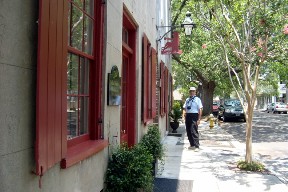
George at the entrance to Catfish Row in Charleston, June 22, 2008.

George at the entrance to Catfish Row in Charleston, June 22, 2008.

Betsy and I were looking forward to celebrating our anniversary on June 22 (a day early) by taking a sunset cruise in Charleston Harbor on a sailing schooner. It had rained the previous day, cutting short our visit to Boone Hall Plantation, but we hoped that Sunday would be better.

As I’ve mentioned we went to church at St. Michael’s Church in the morning, and then walked around The Battery before taking a carriage tour of the historic district.

After the carriage tour we still had quite a bit of time before our cruise, so we decided to get a bite to eat. We had done some internet research and went to the Fleet Landing Restaurant on Charleston Harbor. We were able to eat on the deck and enjoy the breezes coming in from the harbor.

After eating we walked around the historic district some more before we headed to the Aquarium Wharf and the schooner. As we walked we noticed the sky getting darker and darker, but we remained optimistic. We got to the wharf and found the schooner, but there was no one there. A quick phone call confirmed that the cruise was cancelled because of weather. It started raining as we walked back to the car.

Although we didn’t get to take our cruise, we still had a wonderful time in Charleston. To see more of our walking tour click HERE.

Our Charleston Carriage Tour

August 14, 2008
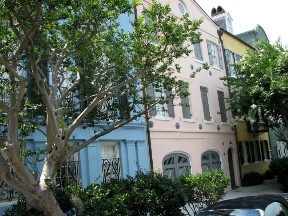
Rainbow Row, Charleston, South Carolina.  June 22, 2008.

Rainbow Row, Charleston, South Carolina. June 22, 2008.

As I’ve mentioned before, Betsy and I were in Charleston, South Carolina, on Sunday, June 22, 2008.  We attended church at St. Michael’s and then walked around The Battery.

We enjoyed our walking tour of The Battery, but it was a very hot day and walking soon lost its charm.  Several horse- and mule-drawn carriages passed us as we walked, so we decided that would be a better way to see Charleston.

We found Palmetto Carriage and bought our tickets.  We were directed to the nearby barn of the company and told that our tour would soon start.  It was there that we discovered that Palmetto Carriage uses mule-drawn carriages.

Our tour guide was excellent and very knowledgeable.  The city of Charleston has a system to limit the number of carriages in any given part of the historic district.  All carriages have to stop at a control point after they are loaded and it is then that they are assigned one of four routes.  So the guides have to be familiar with all four.

We thoroughly enjoyed our tour.  The carriage moved at a slow enough pace that we could see what the guide was talking about.  We would highly recommend this tour to anyone visiting Charleston, especially first-time visitors.

To see more of our carriage tour, click HERE.

Our First Trip to Yahoo Falls

August 12, 2008
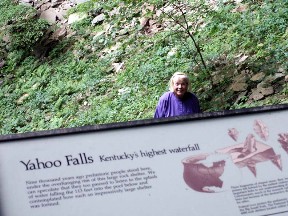
Betsy at Yahoo Falls, June 3, 2006.

Betsy at Yahoo Falls, June 3, 2006.

I’ve mentioned several times that Betsy and I collect waterfalls. We currently have 278 different waterfalls in our collection, and we try to plan our travels so that we visit a new waterfall on each trip. But we also go back to visit favorites when we can.

Most of the waterfalls we’ve visited have been here fairly close to the Glade. One waterfall that we’ve visited several times is Yahoo Falls, in the Big South Fork National Recreation Area near Whitley City, Kentucky. We first visited Yahoo Falls in 2006.

The National Park Service claims Yahoo Falls is Kentucky’s highest. There is more water going over in the late winter and spring than at other times of the year, but Yahoo Falls is still pretty any time of the year.

The trail to the falls from the parking is about a mile long and is very pretty. You can walk right up to the base of the falls and even behind the falls. The trails go up around the top of the falls, but the views from the top are not very good. There is a trail from the falls to Yahoo Arch, which is also quite interesting.

To see more of our 2006 visit to Yahoo Falls, click HERE.

Charleston’s Battery

August 11, 2008
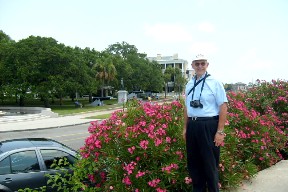
George at The Battery, June 22, 2008.

George at The Battery, June 22, 2008.

After attending church service at St. Michael’s in Charleston, Betsy and I drove down to White Point Gardens, also known as The Battery.  White Point Gardens sits at the southernmost point of the Charleston peninsula, where the Cooper and Ashley rivers meet and flow into Charleston Harbor.  Originally opened in 1837 as a public park, the Battery was fortified during the Civil War to protect the city against Union troops.

The Battery is one of the best spots in the city for strolling.  There are live oaks draped with Spanish moss, pleasant ocean breezes, and lovely views of Charleston Harbor.  The Battery is also home to some of the city’s most lavish residences.

We were able to find a parking spot and walked along the seawall and then through the garden.  We then walked along South Battery and Meeting Streets before heading back to the car.

To see more of our walking tour of The Battery, click HERE.

Memories of China

August 10, 2008

We watched the Opening Ceremonies for the Olympics Friday night.  I think we can all agree that they were very impressive.

I was interested in seeing them because I’ve been to Beijing several times.  I taught in Tianjin, People’s Republic of China, on four separate occasions, and visited Beijing at least once on each trip.

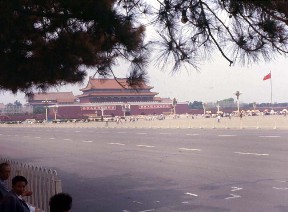
The first time I went to China was in 1987, when the above picture of Tiananmen Square was taken.  China had been ‘open’ for several years by then, but foreigners were still relatively rare.  I managed to attract quite a bit of attention wherever I went.

There were still relatively few automobiles in China at that time — the black bicycle was the usual mode of transportation for most people.  Most older people wore dark Mao suits, and although young people wore white shirts there really wasn’t a great deal of color in the clothes ordinary people wore.

My most recent trip to China was in 1994 – 1995 and by that time things had really changed, at least in the cities.  There were many more automobiles on the roads, but they were still outnumbered by the bicycles.  But now the bicycles were every color under the rainbow.  The clothing of the ordinary citizens, especially the children, was also very colorful.

The announcers Friday night commented several times on the politeness of the Chinese.  I found the average Chinese to be very friendly and considerate on each of my trips, and I have many wonderful memories of China and the Chinese people.

A Family Reunion

August 5, 2008

In July Betsy and I went to her hometown, Big Stone Gap, Virginia, for a Bruce/Cummings family reunion.  Betsy is related to the Bruces and Cummings through her mother.

Betsy knew some of her cousins as a little girl, but she had not seen most of them for years.  Of course, there were many other family members that she didn’t know at all.  So the reunion gave her a good excuse to go back to Big Stone Gap and the opportunity to get re-acquainted with people she hadn’t seen in years.

Betsy is very interested in family history, as is her cousin Ellen who lives in Cincinnati, Ohio.  Betsy and Ellen spent quite a bit of time exchanging information on the Bruce family.

Not only did Betsy get to meet people, we were able to enjoy the beautiful southwest Virginia countryside.  We think we live in a beautiful area here on the Plateau, but those mountains around Big Stone Gap are also very beautiful.  All in all it was a wonderful weekend.

To see more of our weekend, click HERE.

Boone Hall Plantation

July 25, 2008


The two major destinations on our anniversary trip were Charleston and Savannah. We did visit some waterfalls in north Georgia on our way south, but we arrived in the Charleston area on June 21.

Our first stop was Boone Hall Plantation in Mt. Pleasant, South Carolina. Boone Hall is one of America’s oldest working plantations. It was once known for cotton and pecans, but now produces peaches, strawberries, tomatoes and pumpkins, as well as other fruits and vegetables.

Boone Hall Plantation (including the first floor of the main house) has been open to the public since 1956. In the 1980s Boone Hall was featured in the mini-series North and South. Later it was used in the filming of Queen, the sequel to Alex Haley’s Roots.

Boone Hall Plantation got it’s start in 1681 when Theophilus Patey was granted 470 acres of land on Wampacheeoone Creek. John Boone, who arrived in South Carolina in 1672, married Patey’s daughter and the couple received the 470 acres as a wedding present. It was after the marriage that the plantation began to be known as Boone Hall. By 1811, when the Boone family sold the plantation it had increased to 1,452 acres.

Over the next 150 years Boone Hall was sold several times. Over those years the plantation increased in size to 4,039 acres and became one of the leading producers of pecans in the country. In 1955 the McRae family, who still own the plantation, purchased Boone Hall and opened it to the public.

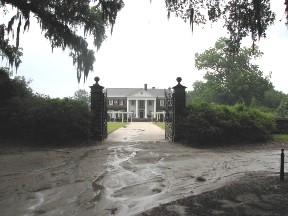
One of the features of Boone Hall is an avenue of oaks — a three-quarter mile driveway leading to the main house lined with massive Spanish-moss draped Live Oaks. The Avenue of Oaks goes back to 1743. The present manor house was built in 1935 on the site of the original house.

To see more of our visit to Boone Hall, click HERE.