Posts Tagged ‘Travel’

America the Beautiful

July 23, 2008

What is the real America?  Is it the big cities we see on television or in the movies, or is it the simpler America of Norman Rockwell?  One reason Betsy and I enjoy living on the Cumberland Plateau is that life here is a little slower and a little simpler than it would be in a larger city.

This weekend we travelled to a portion of the country that is almost as beautiful as our plateau — southwestern Virginia.  We were able to stay off interstate and other major highways most of the time and got to see the America that exists away from the interstate highways.

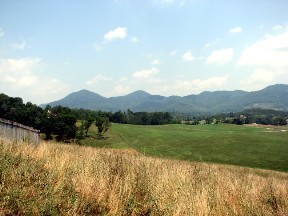
Betsy’s hometown is Big Stone Gap, Virginia.  BSG is a small city nestled in the mountains.  It used to be a center for coal mining, but most of the mines in the area have now closed.

But the mountains are still there and they are grand to behold.  Between the mountains are many wide valleys which contain rolling hills and many farms and small towns.  Every hill and every curve seemed to present a picture postcard view.

It’s hard to put into words the way we felt about the countryside through which we travelled.  Perhaps the best way to put it is to say the Norman Rockwell’s America still exists.
A Very Pleasant Surprise

July 22, 2008

As I mentioned, Betsy and I went to her hometown, Big Stone Gap, Virginia, over the weekend to attend a family reunion.  We had a nice time and I’ll probably have more to say about it in the days ahead.

Now that we have a GPS unit in the car we have travelled more back roads on our trips.  Our GPS — Miss Bar-Beak — knows where we are even on the back roads and can get us to where we want to go.

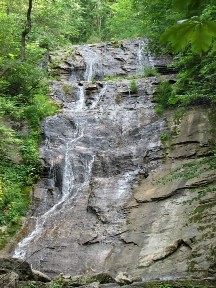
By taking the back roads we get to see some beautiful scenery that we otherwise would not see.  Sunday we were driving through the mountains when we saw a little green sign that said “Elrod Falls” and had an arrow pointing to the right.  Betsy and I looked at each other and asked “Do you think that’s a waterfall?”  Neither of us knew, but we decided to check it out.

We turned around and took the road designated by the sign.  We had a couple of false starts because that was the only sign we saw, but we finally got on the correct road and went further back into the mountains on a gravel road.

The road ended at a picnic area and a short path led us to Elrod Falls.  Since this part of the country is in the second year of a drought we were surprised to see a fair amount of water coming over the falls (see the picture above).

We met a couple who lived in the area at the falls and they said there was much more water in the late winter and early fall.  It looks like we’ll be going back there again!

Fort Sumter

July 13, 2008

Three weeks ago Betsy and I were in Charleston, South Carolina. I had been there several times, but Betsy had never been there.

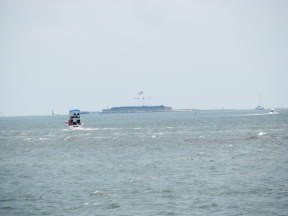
We didn’t have time to take the boat out to Fort Sumter, one of Charleston’s most famous historical sites.

But we did catch a glimpse of Fort Sumter from the Battery (more properly known as White Point Gardens), which sits on the southernmost edge of the Charleston peninsula, where the Cooper and Ashley Rivers meet to flow into the Atlantic Ocean.

Fort Sumter was built on a man-made island in Charleston Harbor. Fort Sumter, a masonary fort, was part of the third system of defenses constructed along the coast and was unfinished when South Carolina seceded from the Union on December 21, 1860. U. S. Army Major Robert Anderson moved his command to Fort Sumter five days later because he felt it was the most defensible position in Charleston harbor that could be held by the Union.

On April 12, 1861, Confederate batteries around Charleston harbor opened fire on Fort Sumter for what became a 33 hour bombardment. After that time Major Anderson surrendered the fort because red-hot shells and started fires in all the wooden structures of the fort and were threatening to explode the powder magazines.

No Union soldiers were killed in the bombardment, but one Union soldier was killed and another mortally wounded on April 27, during the firing of a salute to the American flag allowed by Confederate authorities.

Fort Sumter remained in Confederate hands until February 22, 1865, when Union troops of General Sherman occupied the fort after the evacuation of Charleston by the Confederates.