Posts Tagged ‘History’

Castillo de San Marcos

August 13, 2009
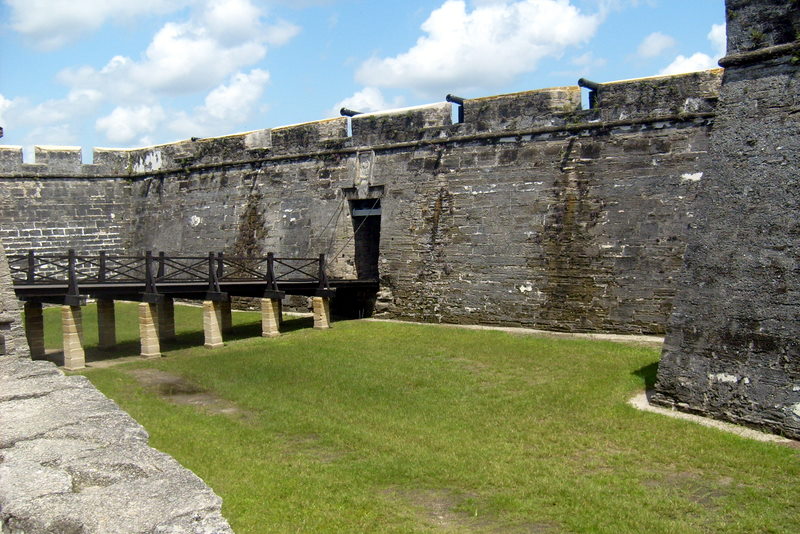
The main gate of Castillo de San Marcos, St. Augustine, Florida.  August 4, 2009.

The main gate of Castillo de San Marcos, St. Augustine, Florida. August 4, 2009.

After visiting Betsy’s brother, Ray, in Jacksonville, we headed south to Ormond Beach for Betsy’s birthday.  We travelled through Saint Augustine, and, since we had some extra time, decided to stop at Castillo de San Marcos.

The Spanish started construction on Castillo de San Marcos in 1672.  The detail and architecture of the fort are both distinctive and unique.  Castillo de San Marcos is the oldest masonry and the only existing 17th century fort in North America.
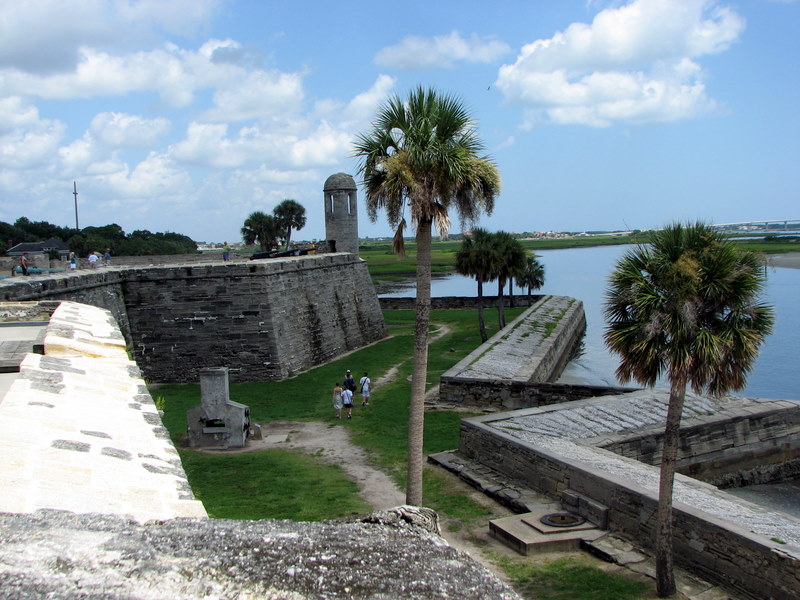
The outer walls of the fort.  August 4, 2009.

The outer walls of the fort. August 4, 2009.

The first 300 years of the existence of the fort were times of constant warfare as European countries vied for the economic wealth of the New World.  The Castillo was attacked many times (mostly by the British) but was never captured.
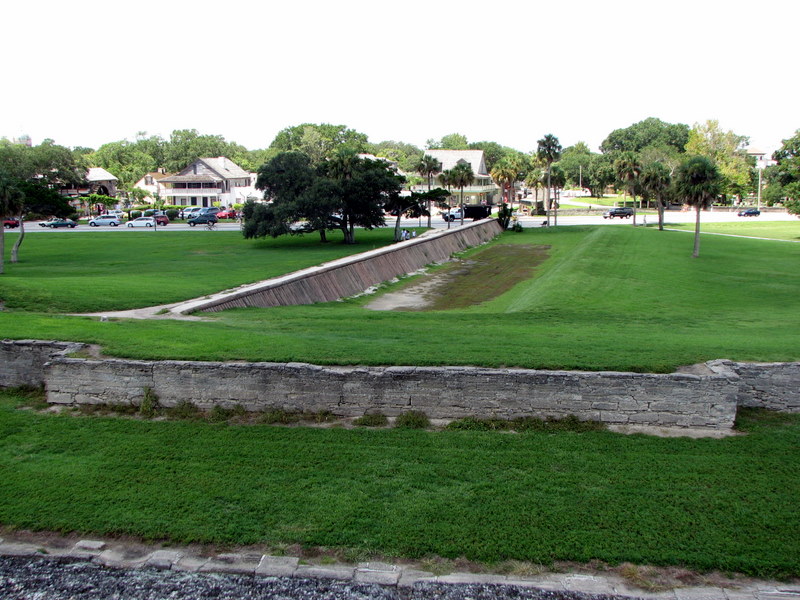
The reconstructed city of St. Augustine, Florida.  August 4, 2009.

The reconstructed city of St. Augustine, Florida. August 4, 2009.

The present National Park Service Monument consists of over 20 acres and includes a reconstructed section of the St. Augustine city wall.

Both Betsy and I enjoyed our visit to this, one of the oldest structures in the U. S.  If you’re ever near St. Augustine visit the fort.  We think you’ll enjoy it.
Jamestown Settlement

July 30, 2009
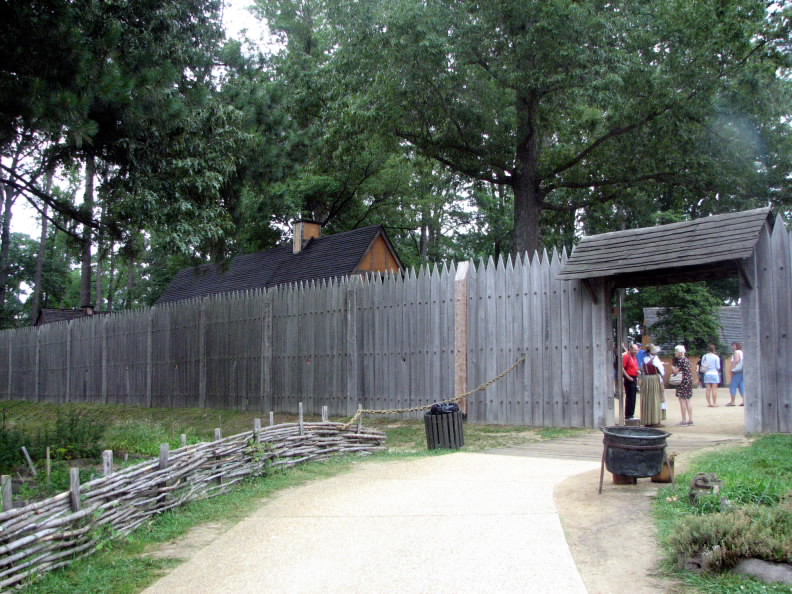
The gate at James Fort in Jamestown Settlement.  June 20, 2007.

The gate at James Fort in Jamestown Settlement. June 20, 2007.

We’ve had rain off and on for the past couple of days, so I’ve been able to get more work done on some of my back-logged photos.  If we had enough rain for me to completely catch up, I think we would all need arks.

The picture above is the entrance to James Fort at Jamestown Settlement in Virginia.  Betsy and I went there in 2007 to celebrate the 400th anniversary of the settling of Jamestown.  Jamestown Settlement is a living-history museum on the road leading to the National Park, so we stopped there first.

Jamestown Settlement includes a film about the first two decades of the Jamestown colony and several galleries of artifacts from both English settlers and Powhatan Indians.  The Settlement also includes a re-created Powhatan Indian Village, replicas of the three ships which brought the English settlers to Virginia, and a full-scale replica of the fort built by the settlers.

You can see more of our pictures from Jamestown Settlement HERE.

Yorktown Victory Center

July 25, 2009
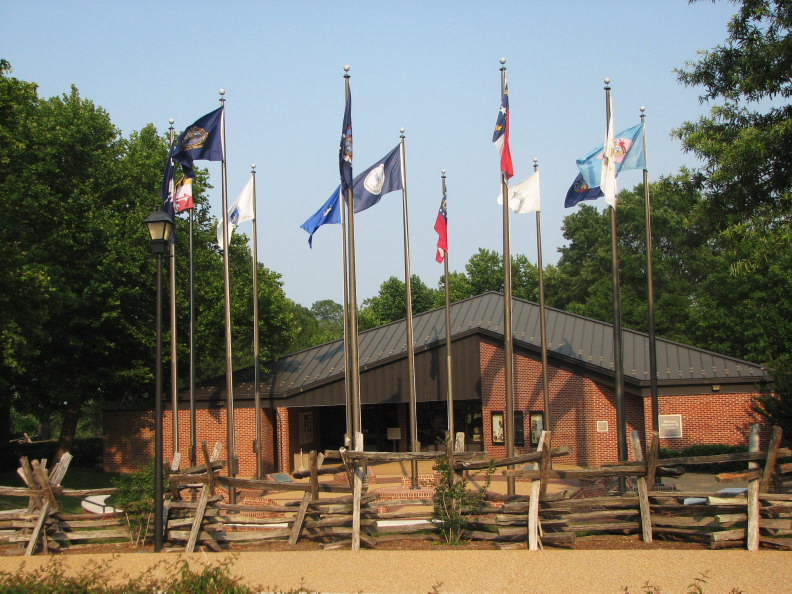
Yorktown Victory Center, Yorktown, Virginia.  June 19, 2009.

Yorktown Victory Center, Yorktown, Virginia. June 19, 2007.

I’ve had a chance to work on photos over the past several days and came across pictures that were taken when Betsy and I visited Virginia in 2007.  We went to celebrate our anniversary and to visit Jamestown, Williamsburg and Yorktown.

The first place we visited when we got to the Colonial National Historical Park was the Yorktown Victory Center.  The Victory Center is a living-history museum that helps bring the American Revolution to life.   In addition to a film about the Siege of Yorktown, there are re-enactors in a Continental Army encampment who help bring that period to life.

We enjoyed our time at the Victory Center and found it to be very interesting.  Afterwards we saw a little of the riverfront in the town of Yorktown.  It was a very nice beginning of our historical vacation.

If you would like to see more pictures from the Yorktown Victory Center, click HERE.

Scenic Sunday # 51: We Hold These Truths

July 5, 2009
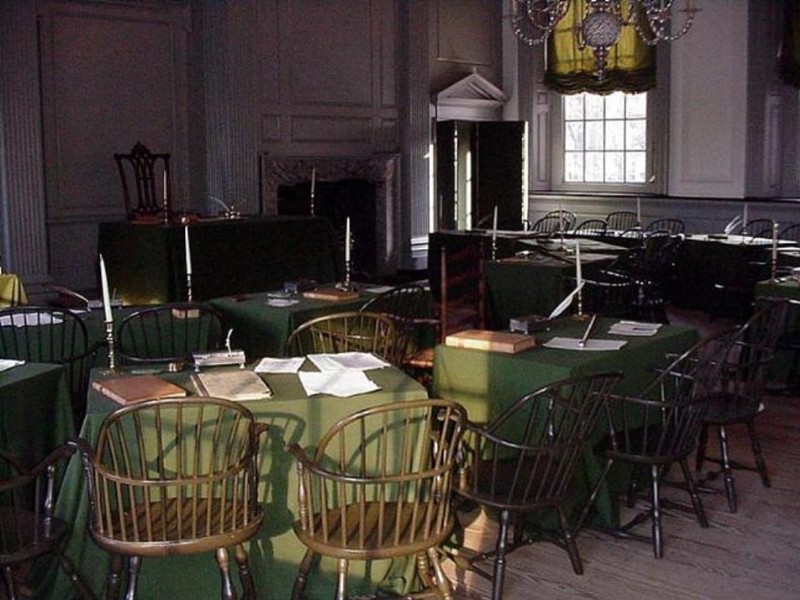
Independence Hall, Philadelphia, Pennsylvania.  November 18, 2000.

Independence Hall, Philadelphia, Pennsylvania. November 18, 2000.

This is my post for the Scenic Sunday meme, which shares beautiful scenes from around the world.  To see more Scenic Sunday posts, or to join and show your own pictures, click HERE.

The picture above may be more historic than scenic, but I think it is appropriate for this holiday weekend.  This is the room in Independence Hall, Philadelphia, in which the Declaration of Independence was signed.  That document laid out the fundamental promise and obligation of a new nation.

… We hold these truths to be self-evident, that all men are created equal, that they are endowed by their Creator with certain unalienable rights, that among these are life, liberty and the pursuit of happiness. …

Two hundred and thirty three years later, work still needs to be done to reach that ideal.  But progress has been made and is being made.  The words of July 4, 1776, still define and animate the nation today.

My World # 34

June 2, 2009
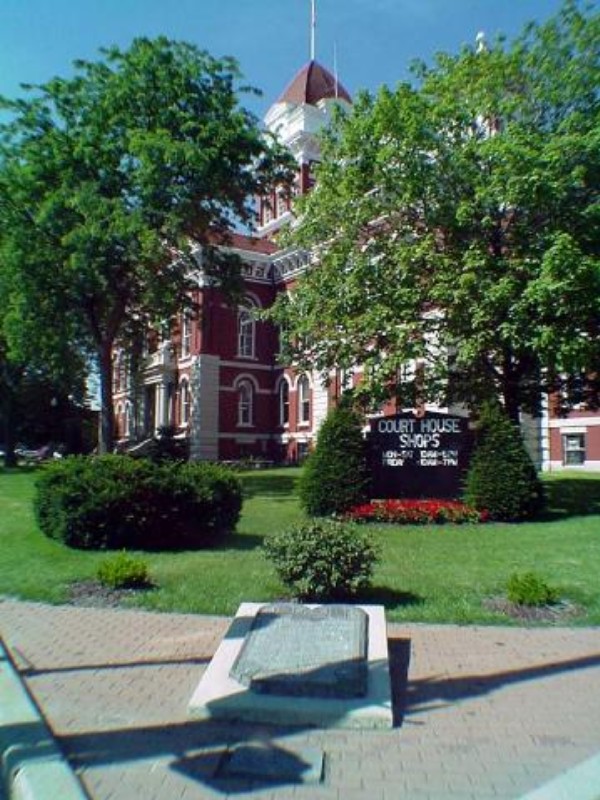
The old Lake County Courthouse, Crown Point, Indiana.  July, 2000.

The old Lake County Courthouse, Crown Point, Indiana. July, 2000.

This is my post for the My World meme.  It is hosted by Klaus, Ivar, Sandy, Wren, Louise and Fishing Guy.  Last week there were at least 74 people sharing their worlds (problems with Mr. Linky).  To see more of our world or to join and share your part of the world, click HERE.

The picture above was taken in 2000 of the old Lake County Courthouse in Crown Point, Indiana.  The courthouse was built in 1878 and served as the seat of the county government during the time I lived in Crown Point.

A new courthouse was built in 1970s  and for a while it seemed that the old courthouse would be torn down in order to create a parking lot.  But a group of citizens succeeded in getting the courthouse listed in the National Register of Historic Places in 1973 and the building was saved.  It now contains shops and a museum.

At the bottom of the picture you can see the a tablet containing the Ten Commandments.  The tablet used to be vertical, but was broken off its pedestal by vandals.  The tablet was then preserved in this position and is still there.

Memorial Day

May 25, 2009
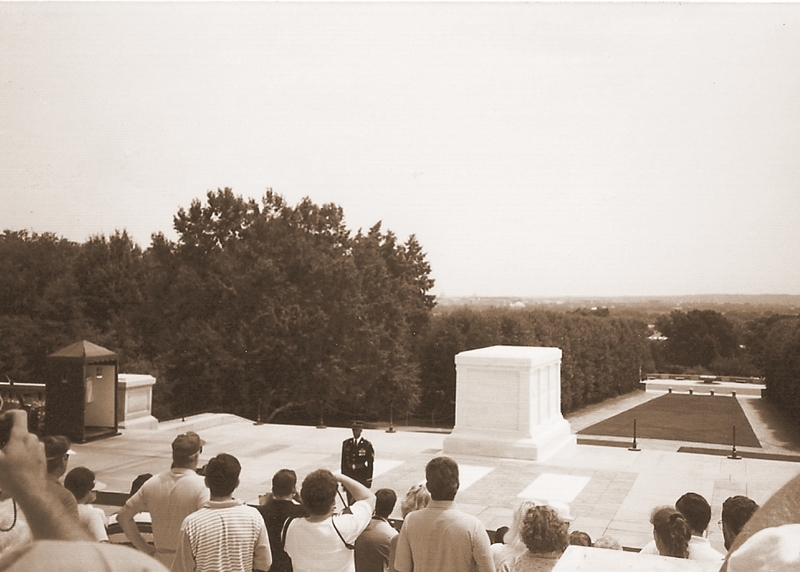
The Tomb of the Unknown, Arlington.  July, 1992.

The Tomb of the Unknown, Arlington. July, 1992.

The picture above is a scan from a photograph of the Tomb of the Unknowns I took in 1992.  The original photograph is now very washed out, so I converted it to sepia.  It’s not a very good picture, but I wanted to include it in this post for Memorial  Day.

Memorial Day, originally called Decoration Day, is a day of remembrance for those who have died in our nation’s service.  There are many stories as to the actual beginnings of Decoration Day, but Waterloo, N. Y., was officially declared the birthplace of Memorial Day by President Lyndon Johnson.  There is  also evidence that organized women’s groups in the South were decorating graves before the end of the Civil War.

Memorial Day was officially proclaimed on May 5, 1868, by General John Logan, national commander of the Grand Army of the Republic, and was first observed on May 30th of that same year.  The first state to officially recognize the holiday was New York in 1873.  By 1890 it was recognized by all of the northern states, although the South refused to acknowledge the day until after World War I, when the holiday changed from honoring just those who died fighting in the Civil War to honoring Americans who died fighting in any war.

The holiday has changed in many ways over the years.  In 1971 Congress changed the date to the last Monday in May to ensure a three day weekend.  As such, Memorial Day is now celebrated as much for the unofficial  beginning of summer as it is for a day of remembrance.

So I hope you will enjoy any special activities that you have planned for the day.  But I also hope you will take a moment to remember those who sacrificed so much to give us the freedom that we enjoy.

Skywatch Friday # 35

March 19, 2009
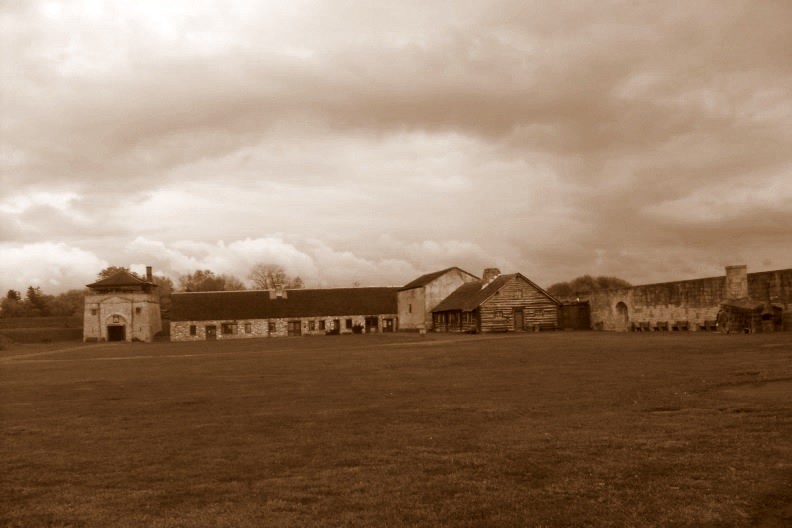
The interior of Old Fort Niagara, New York.  October 25, 2008.

The interior of Old Fort Niagara, New York. October 25, 2008.

This is my entry for Sky Watch Friday, a weekly meme that allows you to see more of the sky from all over the world. Last week over 300 people shared their skies through this meme.  To see some beautiful skies from around world, or to join and share your sky photos with us, click HERE.

When Betsy and I visited by daughter and her husband in Buffalo last October, we also visited Old Fort Niagara.  The fort is at the entrance to the Niagara River not far from Niagara Falls and has been in existence since 1726.

It was a rainy, blustery day the afternoon we visited the fort.  I snapped this picture from the parade ground as more clouds moved in.  Since we were visiting an old military post, I couldn’t resist converting this to sepia.

********************

Just a reminder that you are invited to visit my photo blog, Photos by Senior Hiker, by clicking HERE.

Old Fort Niagara

November 19, 2008
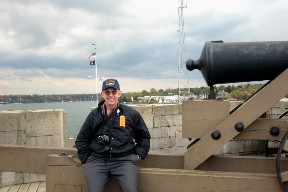
George along the river wall of Old Fort Niagara.  October 25, 2008.

George along the river wall of Old Fort Niagara. October 25, 2008.

In 2002, when Betsy and I went to Niagara Falls the first time, we stayed on the Canadian side of the river.  One day we drove the length of the river from Lake Erie to Lake Ontario and stopped at the Fort George historical site.  From Fort George we could see Old Fort Niagara on the American side of the river.

When we visited Kelly and Chuck last month we had a chance to visit Old Fort Niagara.  Actually we learned that there are two forts sharing the same site.  Old Fort Niagara, the historic site, dates back to 1726.  During the Civil War the garrison expanded beyond the walls of the fort and became the “New” Fort Niagara.  The last army units were withdrawn from “New” Fort Niagara in 1963.

The French were the first to occupy the site of Old Fort Niagara, starting in 1679.  Their first two posts were short-lived, but in 1726 they erected a permanent fortification.  The fortification, the “French Castle”, was designed to resemble a large trading house and is the oldest structure at Fort Niagara.

The British gained control of Fort Niagara in 1759, during the French and Indian War, after a nineteen-day siege.  The British held Fort Niagara throughout the American Revolution but were forced, by treaty, to yield it to the United States in 1796.  Fort Niagara was recaptured by the British in 1813, but was ceded to the United States a second time in 1815 at the end of the War of 1812.

The War of 1812 was Fort Niagara’s last armed conflict — it served as a border post after that time.  The fort was restored between 1926 and 1934 and is now open to the public.

To see more of our visit to Old Fort Niagara click HERE.

We Fly the Battle Flag

October 15, 2008
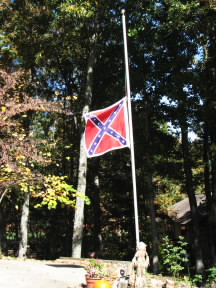
The Battle Flag at half mast.  October 12, 2008.

The Battle Flag at half mast. October 12, 2008.

We fly the Confederate Battle Flag twice each year.  As the picture above shows we fly it a half-mast on October 12 and we fly it at full-mast on January 19.

Robert E. Lee died on October 12, 1870, in Lexington, Virginia (he was born January 19, 1807).  At the time he was  president of Washington College, which is now Washington and Lee University.

I’ve admired Lee for just about as long as I can remember, and that is getting to be a long time!  When I was in the third grade I asked Santa for an encyclopedia, which he brought.  I found a painting of Lee at the Battle of Chancellorsville in the encyclopedia which absolutely fascinated me.  The painting showed Lee on Traveler with the burning Chancellor mansion in the background.  Confederate troops were cheering Lee, but in the lower right hand corner was a wounded Union soldier who was also raising his hat to Lee.  What kind of man could cause an enemy to cheer him?

I know Lee fought for the ‘wrong’ side, but he did so, honorably, for what he thought were the right reasons.  But what I most admire is that Robert E. Lee was a gentleman in the best sense of the word.

So we’ll continue to fly that battle flag twice a year.

Crossing Paths with John Wesley

September 26, 2008
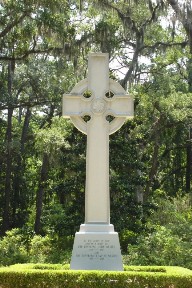
The monument to John and Charles Wesley in Wesley Garden, St. Simons Island.  June 24, 2008.

The monument to John and Charles Wesley in Wesley Garden, St. Simons Island. June 24, 2008.

When Betsy and I were planning our anniversary trip this year, we knew about the Methodist Conference Center, Epworth By The Sea, on St. Simons Island.  Since Betsy worked for the Methodist Church for many years, we knew we wanted to stop by there.

But what we didn’t expect was to encounter John Wesley in so many places.  When we got to Fort Pulaski (on Cockspur Island, Georgia) the first historical marker we saw was to John Wesley.  The marker pointed out that John Wesley landed on Cockspur Island on February 6, 1736, and preached his first sermon in America.  A monument has also been erected on Cockspur Island to commemorate the event.

John Wesley arrived in Savannah, Georgia, on February 8, 1736.  He remained in Georgia until December 22, 1737.  During that time he served as rector to the church in Savannah, and today there is a Wesley Memorial Church in Savannah and a statue of Wesley in Reynolds Square.

During the time Wesley was in Georgia he also went to St. Simons Island and ministered to the settlers in Frederica.  During his visits to Frederica, John Wesley preached near the present Christ Church, Frederica.  There is now a Wesley Garden at the site.

To more of our encounters with John Wesley, click HERE.